
Knowledge-rich behaviour
Why good behaviour in schools is intimately connected to what we know- my essay in the latest Civitas collection.

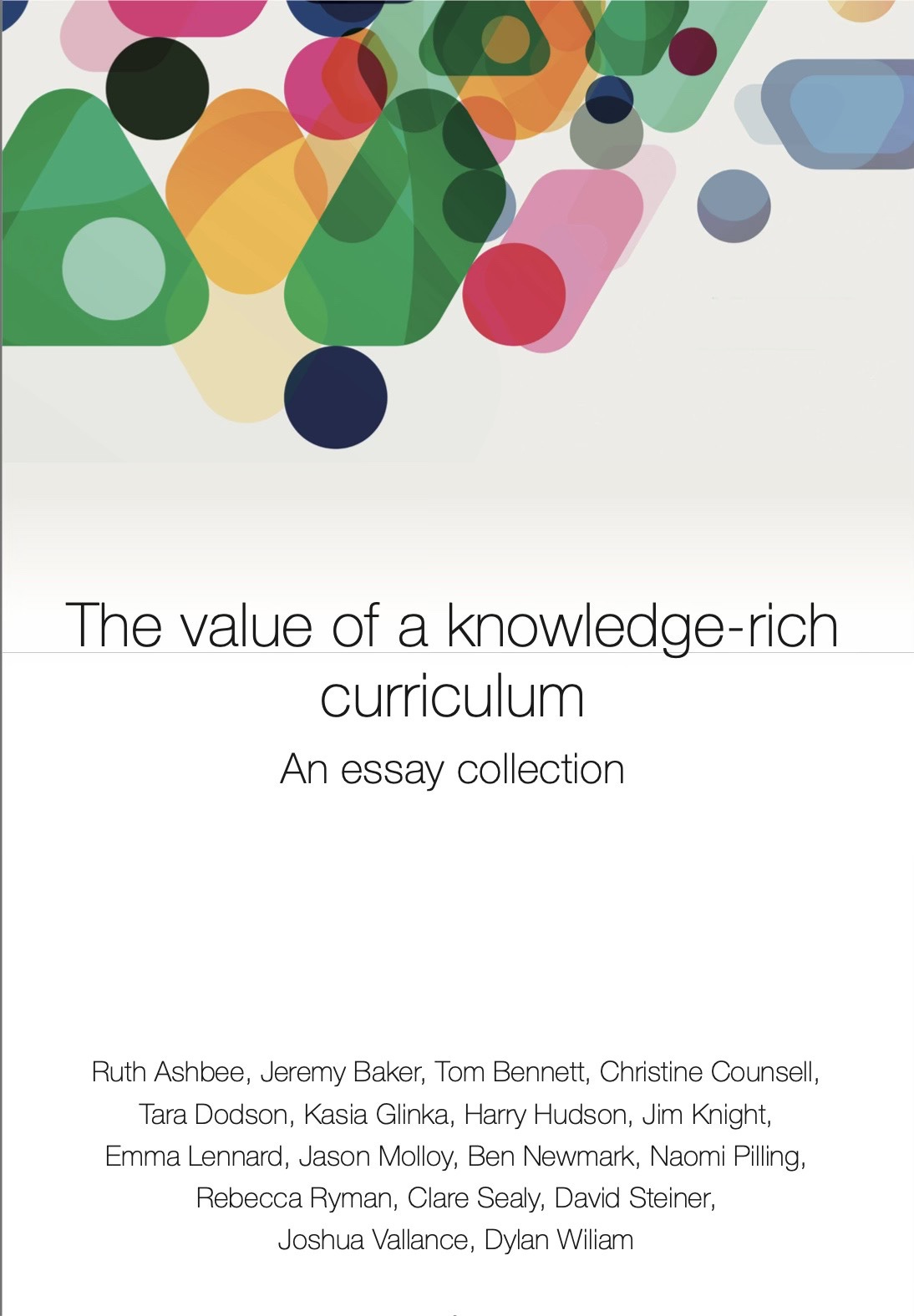
This week Civitas published a collection of essays in book form called The value of a knowledge-rich curriculum: An essay collection. I contributed a chapter to this, perhaps surprisingly given that my territory is normally behaviour, habits and conduct. But as my essay attempts to explain, knowing how and knowing that are both key components of demonstrated behaviour; that behaviour is not just the dumb response of a brute mechanism, but intimately associated with the domain of knowledge in its various forms.
It’s a fascinating collection by some of the best and most brilliant voices in the field, like Christine Counsell, Dylan Wiliam, Ben Newmark and Clare Sealy.
You can download the whole collection online for free here.
Here’s my contribution:
Intellectual discipline: A knowledge-rich behaviour curriculum
Tom Bennett
Recent years have seen a much-needed focus on knowledge: how this knowledge is sequenced (curriculum), how it is taught (pedagogy), and the importance of knowledge as a foundational component – if not the foundation itself – of all subsequent thinking skills, such as creativity or critical thinking. This has slowly become a norm in many educational settings. Knowledge matters – not because it is merely useful, but because it is essential.
But there is an area of education where a discussion of knowledge has been almost entirely absent, and it may be the area where it is needed most in education, even more than in the practice of teaching and learning: behaviour. At first that may not seem surprising: what has classroom or school behaviour to do with the knowledge debate, except perhaps tangentially? Normally we assume that both declarative knowledge (knowing that something is true, e.g. ‘water boils at 100 degrees Celsius at sea level’) and procedural knowledge (knowing how to do something, e.g. being able to replace a car tyre) are primarily concerned with success in academic fields like mathematics or practical subjects like woodwork or athletics (and of course there is considerable overlap between these two categories of knowledge).
But from my work in over 1,300 schools, I posit that knowing-that and knowing‑how are also the invisible foundational components of perhaps the most important feature of a classroom: how students behave.
Behaviour is the conscious response of an organism to a stimulus from its environment. Behaviour is therefore everything we consciously do or say. It is the sum total of our physical actions as we interact with the world. And from that simple definition follows an equally simple but overlooked axiom of classroom practice: how the student behaves has a profound impact on the success of everything we are trying to achieve in the classroom. If a student turns up (or not) or listens (or not) or tries their best (or not) or acts civilly to their peers (or not), and a million other choices of conduct – that forms the basis of whether a student will do well at any part of their education, or the entirety of it. You could have the best curriculum and pedagogy in the world, but if the students don’t listen, try hard and think about the material, or if they are too distracted or terrorised to do so, none of that will matter.
If a student doesn’t ‘behave’, they tend not to flourish. And equally bad or worse is that others around them don’t flourish either. Poor behaviour both characterises and contributes to chaos, and no child flourishes in chaos. Success in any endeavour requires focus, effort, dedication, sustained attention. This is what behaviour means – and behaviour matters like no other component of schooling does.
And where do our behaviours come from? Where are they learned? From our immediate surroundings, our families, our peers, our neighbourhoods, and every experience as we grow up. Consciously or not, we start to develop habits of conduct (everything from accent, to gait, to manners, to social skills, to the expectations of how to walk across a room or use cutlery) and the values that tell us, quietly and secretly, that ‘These behaviours are good’.
Behaviour is knowledge is power
So, our behaviours are learned. I call this the behaviour curriculum, because it is a curriculum. It is a sequence of actions, habits and routines that comprise the total of what we do. Take a small part of this: dining etiquette. I was raised in Scotland, so by default I was shown, and observed, my family using knives and forks; I learned that one went in my left hand, and one went in my right hand. One was to cut and one was to shovel, and they could be used simultaneously for greater effect. Later, I saw my school friends from other cultures using their hands or bread to carry food to their mouths, so I tried that at their houses. At university I struggled with chopsticks in noodle bars; in formal dining I learned that the fork wasn’t a shovel, but a spear; in the Middle East I tried to form balls of food in my right palm while sitting on the floor, and so on. How we eat is learned behaviour. It is performed so often that it goes from the working memory to the long-term memory, and we do it instinctively, subconsciously. Nevertheless, learned it must be. No child is born knowing how to use a knife and fork; it is ‘knowledge’ when we know that a knife cuts, and it is knowledge when we know how to use one. Fortunate children acquire behavioural knowledge when they are raised in circumstances that immerse them in this knowledge, through role models, explicit instruction, consistent expectations, boundaries and consequences.
In every job there are appropriate behaviours that lead to success in the role: a bus driver’s ability to handle a busy road; a surgeon’s skills with a scalpel, and so on. And similarly, at every moment in a school there are behaviours that lead towards or away from success in that environment. Seen in this light, good behaviour isn’t just a moral question, it’s a practical one. Do you know how to behave? Do you have the habits of behaviour that lead to habitually doing that which makes you successful? In a school, that might mean behaviours as mundane as knowing what to do in group work; knowing how to conduct oneself in assemblies; knowing how to get to the next lesson quickly; and so on. These atoms of behaviour are as ordinary as you can imagine, but they become molecules, they become substantial. With this powerful knowledge, children can be successful at school. Being without it makes all the difference.
People need to have the procedural knowledge to be able to do the right thing at the right time. Then, crucially, this has to habituated, internalised and made routine so that the correct behaviour is performed at the right time with little effort of recall. Like an experienced driver instantly knowing what to do when a car goes into a skid. This requires deliberate, repetitive, high-quality practice over and over again (another useful parallel with the academic learning process, demonstrating that learning is, indeed, learning, in whatever field).
So, what type of knowledge?
Behaviour knowledge can be sorted into three broad categories:
· Procedural knowledge: This is the sum total of knowledge that is required to navigate a complex environment: an airport, a public toilet, a bathroom, a ticket office, including knowing where to go, what to say and what to do. This kind of knowledge feels obvious and easy until you encounter a situation where you have no experience, like a Westerner perplexed by the operations of a Japanese electronic toilet, or a Martian walking into a barn dance. You do not know what you do not know.
· Social knowledge: This is the knowledge of how to behave with other people. None of this is instinctive. No one is born ‘good with people’. Understanding social cues, reading others’ responses, interpreting irony, picking up on hostile cues, are all part of a profoundly complex and empirical journey of discovery. This type of knowledge is vital to successfully navigating a human world.
· Knowledge of rules and consequences: This is knowing what is expected of us. What are the rules? What happens if I break them? What happens if I keep to them? Why are they in place?
How should schools teach this knowledge – and what knowledge should they teach?
Once we understand that behaviour is a knowledge-centred curriculum, then things get a little simpler. People tend to think behaviour is something that you are either good at or not, or that it’s an entirely moral choice to do the right thing or not. But if we understand that ‘the right thing’ is not just a moral question but a practical one too, then it is easier to grasp that behaviour is a curriculum of practiced knowledge, procedures and techniques (leading to skills) as much as geography or acrobatics. It then follows that the way to promote good behaviour in school is therefore to teach it. And as we know a lot these days about teaching, we can apply those processes to behaviour. We have a core agreed curriculum of content. We teach students the declarative and procedural content they need, using direct instruction, then formative assessment, leaning heavily into practice to create habits, all the while relying on retrieval practice. In other words, we should teach behaviour like anything else, but with greater urgency, because success in this field contributes to success in all others. It is a profound and happy coincidence that just as education is reinvigorating itself with a renewed focus on evidence-informed practice, so too does that lens swivel around to the factor that dominates all others: student conduct, the furnace from which all other capacities are forged.
The impact of being behaviourally knowledge rich
There is an obvious theory of change implicit here: people who are taught to do something tend to perform better at it than those who are not. People who have been taught to drive are better at driving than those who have not. Teaching people to drive is not enough to guarantee good driving, or to ensure that drivers will always make good choices, but it is unquestionable that teaching the cohort in the first place is infinitely preferable to not doing so. The explanatory mechanism for knowledge-rich approaches to behaviour are axiomatically self-evident. But if the impact of being behaviourally knowledge rich were not demonstrated ‘in the wild’, then there would be no point. So, have we seen success in this area? Yes we have. Increasingly, and especially in England where this idea has taken root more firmly than anywhere else in the Western world, we see a burgeoning and inspirational movement in the many schools that recognise and adopt behaviour as a curriculum and have seen extraordinary dividends in terms of conduct and learning gains. Exemplar schools, from the celebrated Michaela Community School, Mercia Academy, King Solomon Academy, Charles Dickens Primary School and Bedford Free School, to the Harris Federation academies and Stanley Road Primary School, and many more, have made the deliberate choice to ‘scaffold’ the behavioural knowledge that children require to not merely survive but to thrive in the complex environment of institutional education.
Many of the schools listed above have frighteningly good outcomes, and this is particularly significant in light of the challenges and risk factors faced by the student cohorts they serve. It is one thing to demonstrate success in a privileged environment composed of well‑supported and socially or intellectually nurtured groups of children; to see it in groups of children disproportionally exposed to disadvantage, poverty and disruption is remarkable. It is a testimony to not only the schools’ ambition, but also to the strategy of taught behaviour.
As the behaviour advisor to the Department for Education (DfE) since 2015, I have been proud to be part of an institutional, national and political reform process in the English education system that has seen these ideas become normalised. The DfE’s 2024 Behaviour in schools guidance,[1] which I helped to write, centres the idea of the behaviour knowledge curriculum, and schools are encouraged – not mandated – to do so. This has made it possible for ambitious and capable teams to act decisively by implementing clear, assertive and structured approaches to their in-school behaviour practice, knowing that it is supported by national guidelines. Ofsted, the school inspectorate that holds so much sway in the English school system, has also advocated strongly for clear school behaviour policies that are implemented systematically, and taught diligently. Since 2024 it has aligned its inspection criteria with the DfE’s behaviour guidance, resulting in a coherence of approach that was previously absent. With this unity of purpose, many schools have improved handsomely.
Pushback
With so much evidence informing this process, as well as proof of concept within the school sector, why hasn’t this approach been universally embraced? The reality is that there is still a lot of pushback, resentment and disagreement with the knowledge-rich behaviour curriculum.
But the facts and the circumstances remain. Knowledge-rich perspectives on education, and the behaviour associated with that education, have been, and are, profoundly successful. How do we know that ‘progressivism’ doesn’t lead to similar success? Before I address this, let me first briefly outline what I mean by progressivism: it is characterised by child-led education in which children are natural learners, their interests should be the guide to their curriculum, and they should be allowed as much autonomy as possible. Crucially, within this approach strict discipline is not only unnecessary, but considered actively harmful.
So, to return to the question of why it can be said that progressivism doesn’t lead to the same success as a knowledge-rich approach in this context. In my view, this is for the following reasons.
1. Lack of counter examples: There are simply no examples of schools with challenging cohorts that succeed with minimal guidance in behaviour; without clear, well‑taught boundaries and expectations; and without well-rehearsed routines and social norms. Children do not simply self-organise, no matter how much you love them, or how much independence you give them.
2. A chaotic theory of change: Progressivism sprung from 19th century empirical science. Given the new success of the scientific method, it was hoped that the social sciences could be equally transformed by this process, hence ‘progressivism’. But like many first drafts of social science, such as Freud’s theories in psychology, what we know now has massively outstripped what they thought they knew then. The philosophy of the 19th century cannot compete with the data of the 21st century.
3. Evidence of failure: We find many, many examples of schools that descend into chaos when they attempt to avoid the need to teach behaviour. Whenever we see a school close through chaos, or the news reporting a near riot, or students or staff protesting because of chronic misbehaviour, there is always a backstory of permissiveness, and an over-optimistic view of human nature or the nature of society.
Without knowledge of how to behave, every other endeavour in education is obliterated. And this applies to society at any level, including, or even especially, at the classroom level, which is almost entirely composed of children who, by definition, are learning how to behave. Our approach to behaviour must also be knowledge rich. And thankfully, across the world, many are waking up to this. It is now known.
[1] Department for Education (2024) Behaviour in Schools: Advice for headteachers and school staff. Available at: https://assets.publishing.service.gov.uk/media/65ce3721e1bdec001a3221fe/Behaviour_in_schools_-_advice_for_headteachers_and_school_staff_Feb_2024.pdf (accessed 22/10/25).